
LSO Discovery
Free Friday Lunchtime Concert
TODAY'S CONCERT
Franz Liszt
Les Jeux d’eau à la Villa d’Este
Maurice Ravel
Jeux d’eau
Tania León
Homenatge
Xavier Montsalvatge
Ritmos
Rachel Leach presenter
Owen Lee piano
USING YOUR DIGITAL PROGRAMME
- Connect to the free hawksmoor WiFi network.
- Navigate using the menu icon (≡) at the top of the screen.
- Please set your phone to silent and don't use other apps during the music.
Franz Liszt (1811–1886)
Les Jeux d’eau à la Villa d’Este
✒️ 1877 | ⏰8 minutes
Liszt’s incredible life and career divides quite neatly into two halves. First, he was superstar pianist and composer, touring Europe with swooning fans at his concerts – a phenomenon known as Lisztomania. Then, after several personal tragedies, he became reclusive and religious, preferring solitude and introspection to fame and adulation. This piece comes from the last decade of his life and is part of a set called Years of Pilgrimage. It was written in 1877 during a trip to Villa d’Este near Rome and it depicts the flowing water of the many fountains and water jets in the gardens. It is also one of the first pianistic depictions of water and inspired many that followed. But it is also symbolic of Liszt’s life of contemplation. He wrote on the score the biblical quote: ‘The water that I shall give him shall become in him a well of water springing up into eternal life’.
Note by Rachel Leach
Maurice Ravel (1875–1937)
Jeux d’eau
✒️ 1901 | ⏰5 minutes
Ravel was born in France close to the Spanish border. His Spanish mother was an amateur musician and his father was an inventor of engines and machines. The family moved to Paris when Maurice was only months old and he grew up to be one of the greatest French composers of all time. In 1901, however, he could hardly have imagined that this would be his future. He had just been expelled from the Paris Conservatoire for failing to win any composition prizes. He was 26 years old without a career or fame. His teacher, Gabriel Fauré, agreed to continue teaching him and in a blast of inspiration this piece emerged. Obviously inspired by Liszt, it also depicts water, but rather than being a description of a fountain it portrays the joyfulness, playfulness and beauty of water dancing in nature. Ravel also placed a quote on the manuscript, from a poem by his friend Henri de Regnier: ‘The river god is laughing at the water that tickles him.’
Note by Rachel Leach
Tania León (b 1943)
Homenatge
✒️ 2011 | ⏰8 minutes
León is a ground-breaking Cuban-American composer. Born in Havana, her musical talent was spotted early by her grandmother who noticed how she reacted to music on the radio. Piano lessons followed from the age of four, and in 1963 she earned a BA in music. Soon after, León left Cuba as a refugee and made a new home in New York City. In 1969 she was a founding member of the Dance Theatre of Harlem leading its music department, school and orchestra. Many of her early works were written for the company. Since then she has gained fame and many awards becoming the first African-American woman to win the Pulitzer Prize in 2021. Homenatge, a Catalan word for homage or tribute, was written in 2011. It blends Cuban dance rhythms with bluesy harmonies. In a full circle moment, it was recently choreographed and performed by the Dance Theatre of Harlem, León's first professional home.
Note by Rachel Leach
Xavier Montsalvatge (1912–2002)
Ritmos
✒️ 1942 | ⏰3 minutes
One of the most important Catalan musical figures of the last 50 years, Montsalvatge was born in Girona in 1912 and started his musical life with violin lessons. He then studied violin and composition at the Barcelona Conservatoire and later returned to the institution as lecturer and finally Professor of Composition in the 1970s. Alongside his composing and teaching he was an influential music critic, writing for many publications from the 1940s onwards. Montsalvatge’s music reflected many styles and influences including 12-tone serialism, Wagnerian Romanticism and polytonality (you can clearly hear the latter in this piece). He wrote music in all forms from small chamber pieces to large-scale opera. Ritmos is from 1942. It is inspired by a nostalgia for traditional social dances and features several Spanish dance hall rhythms.
Note by Rachel Leach
About the Artists
Owen Lee
piano
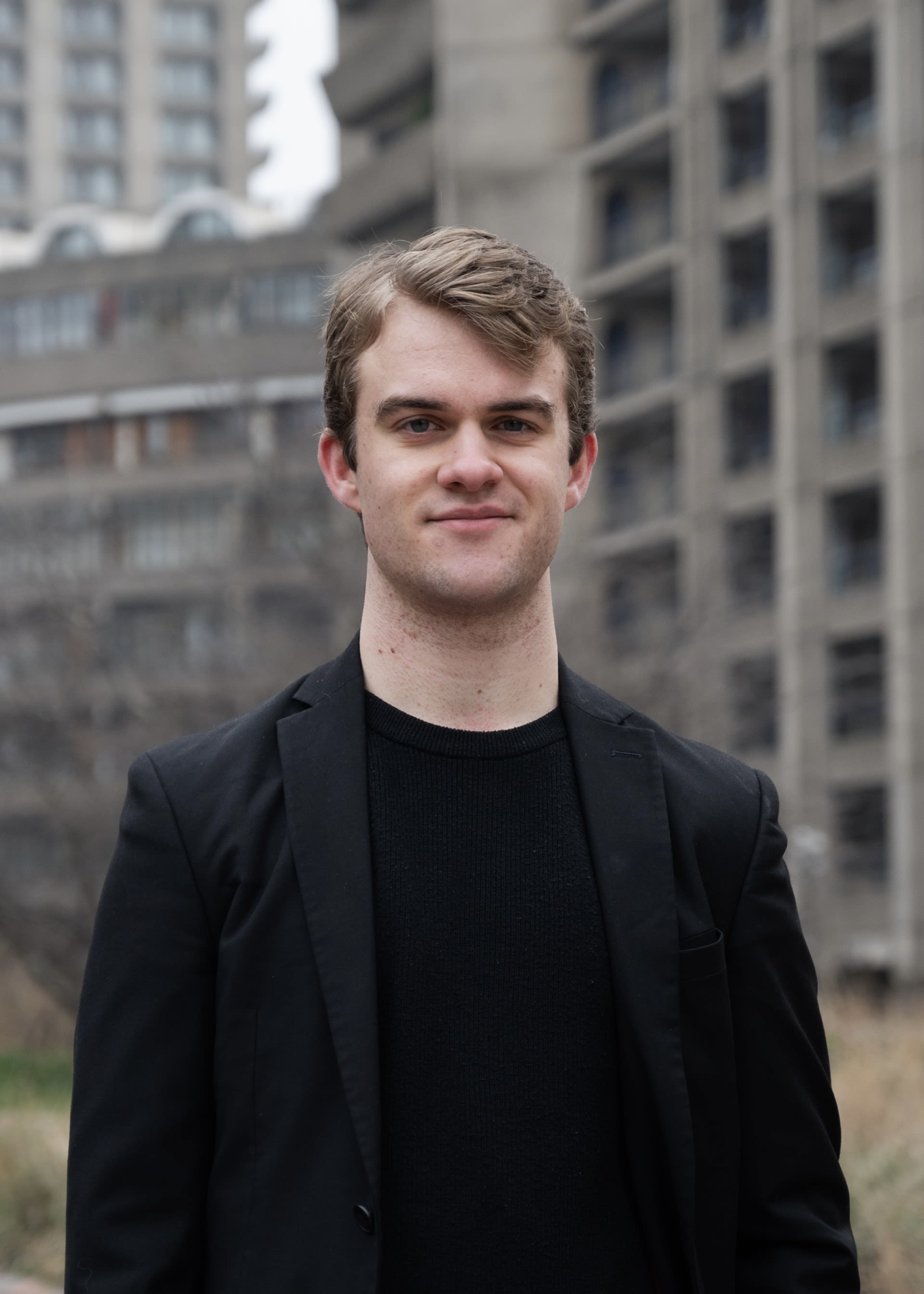
Owen is a pianist and scholar at the Guildhall School of Music & Drama, where he is currently a first-year postgraduate student studying with Carole Presland and Ronan O’Hara. During his time at the school, he has been a finalist in the Romantic Piano Prize and has had the opportunity to perform in masterclasses with pianists Jarred Dunn, Inna Faliks, Ralf Gothóni and Péter Nagy.
Originally from Bishop’s Stortford, Owen began learning the piano aged four, studying with Susie Savage up until the age of 13.
In 2017, he won a scholarship to the PianoMan Scheme, studying in London with Richard Meyrick, Gabriele Baldocci and Veronika Ilinskaya. The programme provided numerous opportunities to collaborate with singers and instrumentalists, including Michael Lafferty and Barbara Luccini.
As a member of the Albero Trio, he has won the Guildhall School’s Ivan Sutton Chamber Prize and played at the Cambridge Summer Music Festival and Fidelio Café in London.
In addition to piano, Owen has continued learning the trumpet with William O’Sullivan and Tom Walsh. He has played major orchestral works with the YMSO and performed as lead trumpet with Guildhall Big Band and the National Youth Jazz Orchestra.

Rachel Leach
presenter
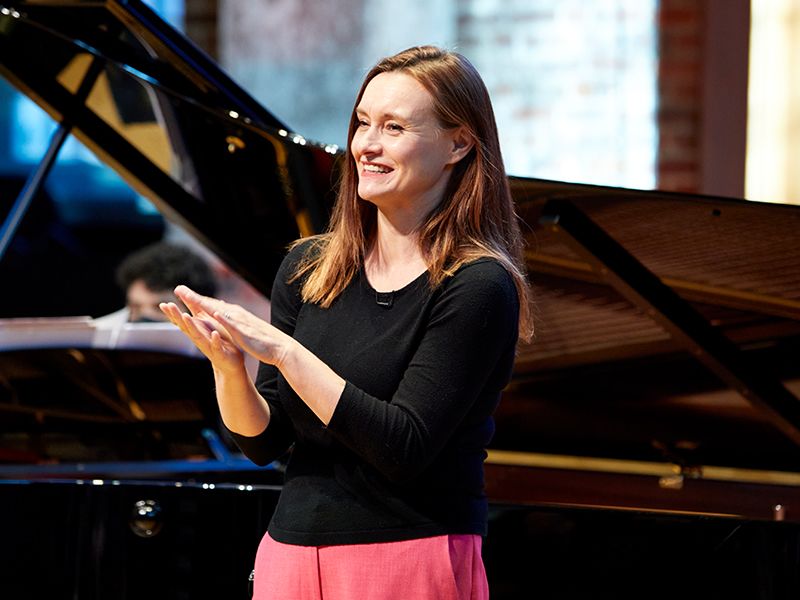
Rachel Leach was born in Sheffield. She studied composition, and her music has been recorded by NMC and published by Faber. She has won several awards including, with English Touring Opera (ETO), the RPS award for best education project 2009 for One Day, Two Dawns.
Rachel has worked within the education departments of most of the UK’s orchestras and opera companies. The majority of her work is for the London Symphony Orchestra and the London Philharmonic Orchestra. Rachel has written well over 20 pieces for LSO Discovery and 15 community operas, including seven for the English Touring Opera.
Increasingly in demand as a concert presenter, as well as presenting the LSO Discovery Free Friday Lunchtime Concert series, she regularly presents children’s concerts and pre-concert events for the LSO, LPO, Philharmonia Orchestra, Scottish Chamber Orchestra, Royal College of Music and Royal Northern Sinfonia.

© Kevin Leighton
© Kevin Leighton
Your Feedback
Thank you for joining us for this Friday Lunchtime Concert.
Please let us know what you thought of the concert by completing a short survey. We would love to hear your thoughts.
Next Friday Lunchtime Concert: LSO Principal Flute Gareth Davies
Friday 9 October 12.30pm
Allison Loggins-Hull
Homeland
Lowell Liebermann
Sonata for Solo Flute Op 151 (UK premiere)
Steve Reich
Vermont Counterpoint
Gareth Davies flute
Rachel Leach presenter
 Built with Shorthand